


Claude.ai, Cowork, Claude Code, Claude in Chrome… Anthropic keeps adding "surfaces" to use its models, and the first reaction is usually the same: which one do I open, and what for?
I use the three main ones every day. Here's how I place them — and why the right choice has less to do with the surface than with the person using it.
Three surfaces, three interfaces
A surface is a way of reaching the same engine — the LLM — through a different interface and a different context.
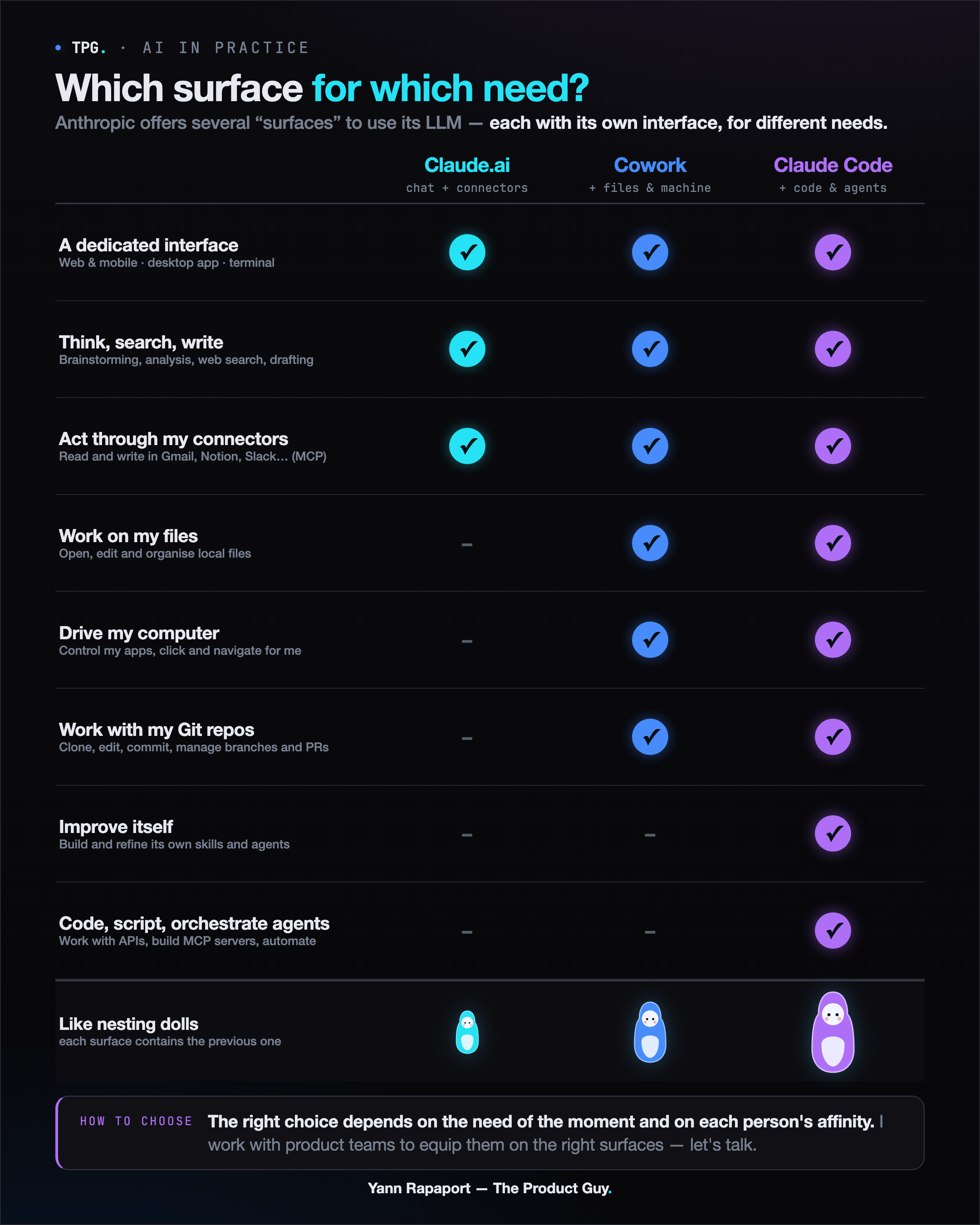
- Claude.ai — the chat, on web and mobile. You think, search and write there, and plug in your tools through connectors (Gmail, Notion, Slack…).
- Cowork — the desktop app. It adds access to my local files, control of my machine, and interaction with my code repositories.
- Claude Code — the terminal. It adds code, scripts, MCP, autonomous agents, and the ability to build and refine your own skills.
The nesting doll model
These surfaces aren't competing: they nest. Each one does everything the previous one does, and a bit more. Claude.ai fits inside Cowork, which fits inside Claude Code.
The practical consequence: the further out you go, the more capability you gain — and the more technical ease you need.
Choosing your surface: a matter of affinity
The reflex would be to push everyone towards the most powerful surface. That's a mistake.
In coaching, I see two clear profiles. The first want full control: they go into Claude Code, get into the implementation, write their own skills and build themselves a second brain, their way. The second want a tool that works out of the box, so they can stay focused on their job without managing any tooling.
Both are right. The right choice depends on the need of the moment and on each person's temperament, not on a level to reach.
The company stake: consistency before advanced use
At team scale, the urgent thing isn't manufacturing a handful of power users. It's establishing consistent practices that move everyone forward, otherwise the gap widens between the most comfortable and the most reluctant.
Once the tooling is in place, a second question arrives fast: how do you maintain shared prompts, skills and connectors? Updating them, validating them, making sure everyone gets the latest version. Maintaining this AI infrastructure is the next piece of work for product teams.
In short
There's no such thing as the right surface in the absolute. What counts is equipping each person and each team with the one that suits them — and keeping that tooling alive over time.
That's what I work on with product teams. If it's a live topic at your company, let's talk.